


Even in a global scenario of cutbacks in ESG investments, as pointed out in our Annual Report 2024, we remain convinced that sustainability is a competitive differentiation strategy — not just a response to regulation.
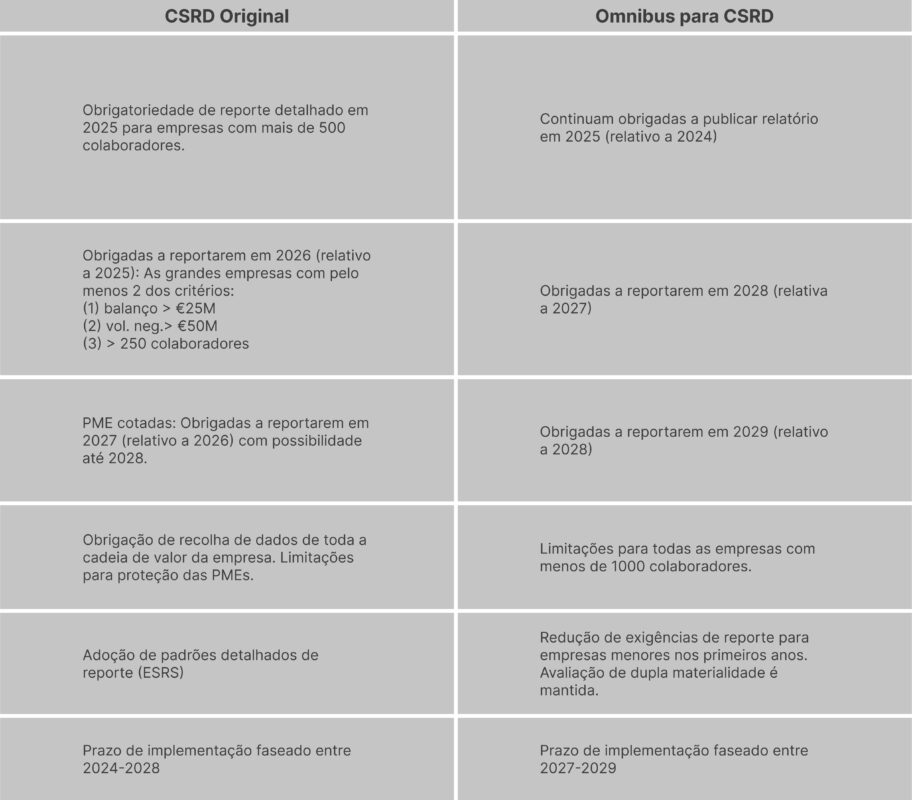
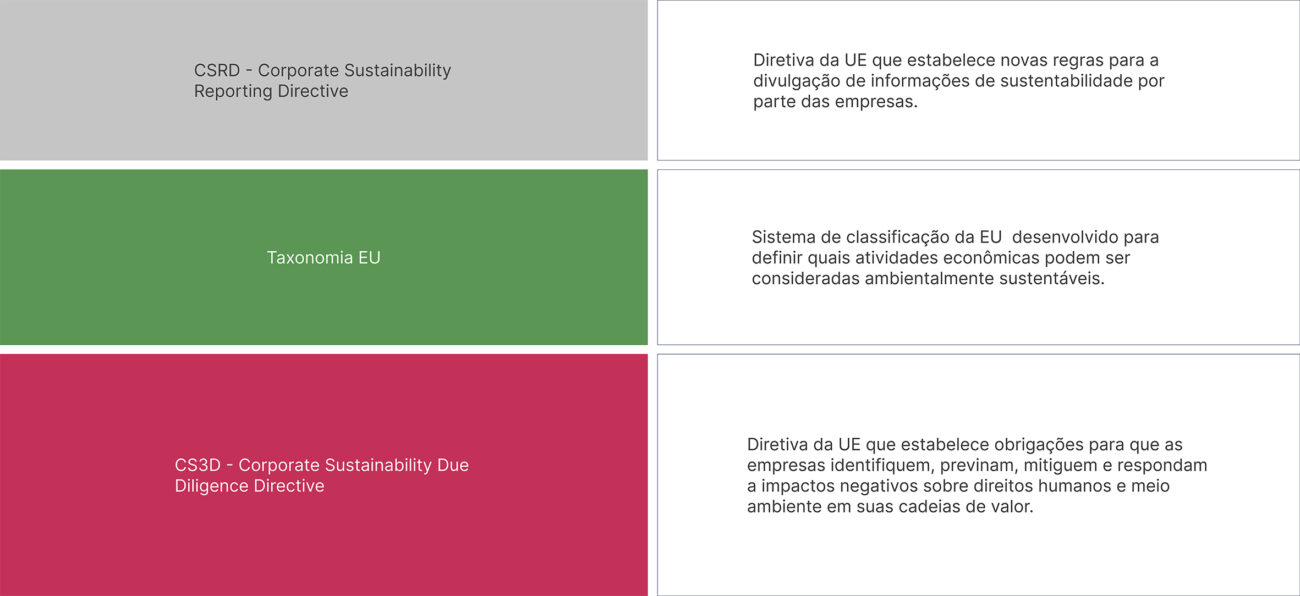
Europe is experiencing a crucial moment of regulatory transition, especially with regard to Corporate Sustainability Reporting Directive (CSRD). The recent “Omnibus Package", proposed by the European Commission, introduces significant adjustments, such as the postponement of deadlines and the simplification of CSRD requirements, creating a scenario of uncertainty for companies and even a setback in terms of sustainable ambition.
We believe that, even in the face of regulatory uncertainty, ESG remains a strategic pillar and competitive advantage for those who choose to move forward with transparency and innovation.
European Context: Simplification with Risks
Europe faces a real challenge in terms of productivity and competitiveness. In response to this situation, the EU has proposed the “Omnibus Package”, which aims to simplify the CSRD and reduce the administrative burden on SMEs — an attempt to prevent overregulation from stifling innovation and investment.
Although the European Commission ensure that the central objective ofEuropean Green Dealremains intact, this simplification may come at the expense of reduced transparency, demobilisation of investments in sustainability, and a loosening of reporting requirements, which could be seen as a step backwards in the European Union's sustainability agenda. Companies that have proactively invested in the adaptations proposed by the CSRD now find themselves in an ambiguous position — between frustration at the relaxation and the opportunity to lead by example.
These companies can take on a new leading role by demonstrating ESG maturity, even when regulation is scaled back.
At Transforma.aí, we recognise this movement as a strategic turning point: those who maintain their commitment to the ESG agenda now are likely to stand out significantly in the medium and long term.
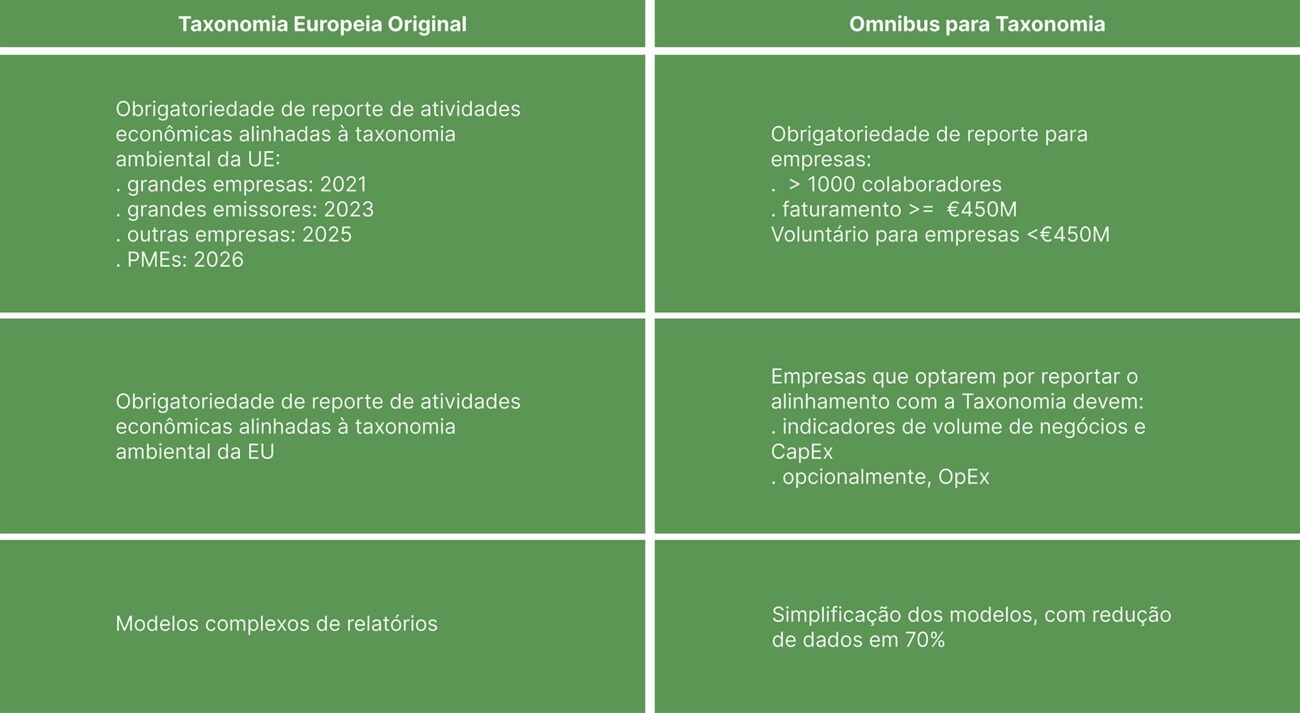
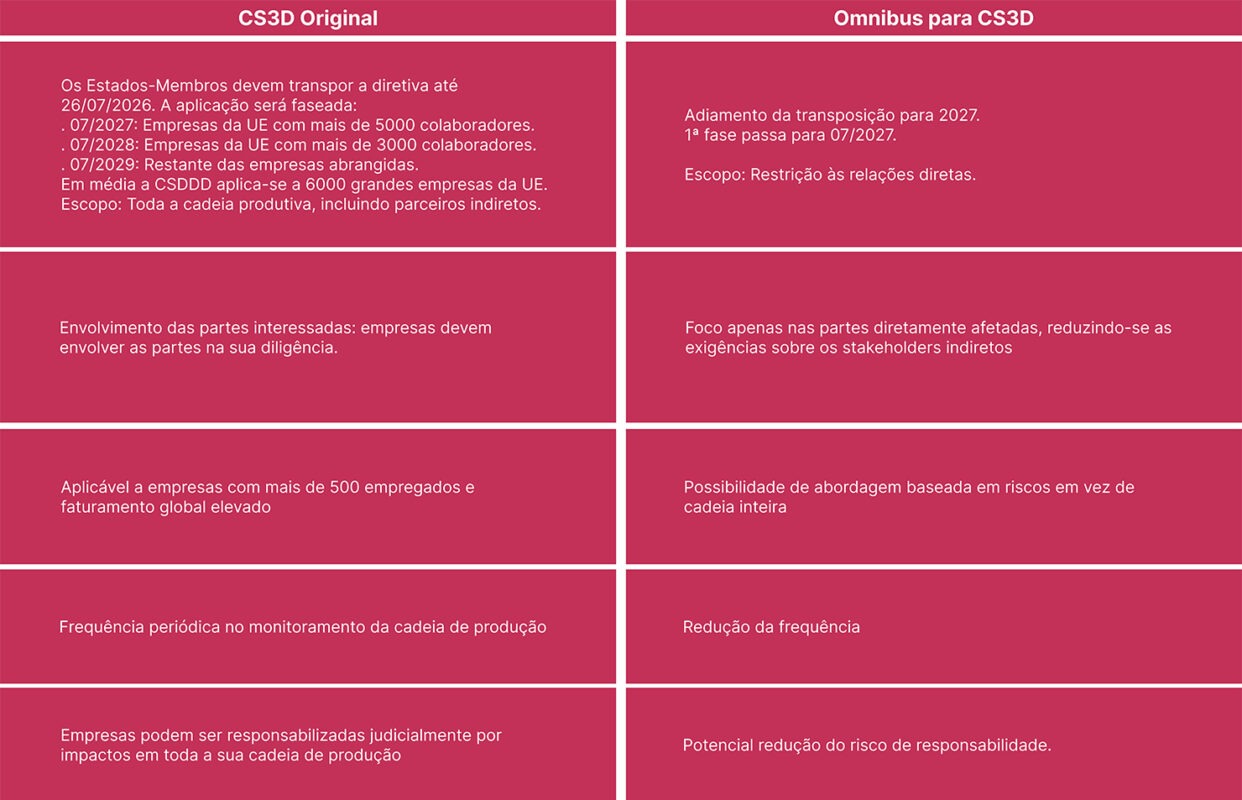
Main changes proposed by “Omnibus Package”
Impacts on Businesses: Uncertainty and Opportunity
Despite changes proposed by the Omnibus Package, ESG has not lost its relevance – this is what we want to highlight! On the contrary, companies that continue to prioritise sustainability in their strategies can benefit from a significant competitive advantage. Transparency and commitment to ESG practices are increasingly valued by investors, consumers, and business partners.
That is why voluntary sustainability reporting — such as that which we developed throughout 2024 — has established itself as a tool for market differentiation.
In a year when the downturn in ESG investments was felt in the market, we observed that organisations that continued with their impact commitments increased their public recognition and influence in the territories where they operate.
For example: Reports and diagnoses delivered by Transforma.aí during the last year involved 106 schools, mapped more than 290 stakeholders, and directly impacted approximately 5,500 people in different regions of Brazil and Portugal.
And Brazil?
Although Brazil isn't directly subject to the CSRD, it is an integral part of global supply chains—especially in the agriculture, energy, and basic industry sectors. This means that Brazilian companies need to be prepared to respond to potential ESG reporting requirements from international partners, or risk losing competitiveness in strategic markets.
Domestically, our performance in 2024 demonstrated that aligning local standards with international benchmarks—voluntarily and strategically—generates real value.. Socio-environmental diagnostic projects, risk analyses based on the Equator Principles, and the implementation of theories of change with precise indicators have demonstrated that it is possible to act locally with global impact. On our international front – we are advancing methodologies for ESG maturity analysis for startups and incubated organizations in Portugal, consolidating our transnational vision of impact.
How Transforma.ai views opportunities to contribute
At Transforma.aí, we understand that regulatory uncertainty should not be an obstacle, but rather an opportunity for companies to position themselves proactively and transparently.
Therefore, in 2024, we restructured our business across four strategic fronts — Risk and Compliance, Positive Impact, Management – Evaluation – Technology and Strategic Communication — to deliver integrated and customized solutions for the most complex ESG challenges.
We operate from start to finish — from diagnosis to reputation building.
From stakeholder mapping and socio-environmental risk analysis to building narratives, reports, and indicators that strengthen reputation and facilitate engagement with investors, communities, and other strategic audiences.
But generating data isn't enough. The question is: what are you doing with it? In a landscape rife with generic ESG metrics that are poorly connected to the core business, our differentiator lies in transforming technical data into strategic arguments. We translate complexity into clarity — and that generates action..
Our commitment's to integrate ESG into business strategy with pragmatism, innovation, and a sense of urgency. That's why we developed the Transforma.aí platformA digital solution that enables real-time monitoring of key indicators, with dynamic dashboards that facilitate quick, assertive, and impact-driven decisions.
Today, more than ever, the market demands more than compliance. It demands consistency, intelligence, and the ability to demonstrate, with evidence, that ESG is part of the business — not an add-on.
Sources of information and inspiration:
- European Commission
- PwC
- Marcos Pinheiro – Executive Director of the Connected School Institute

