


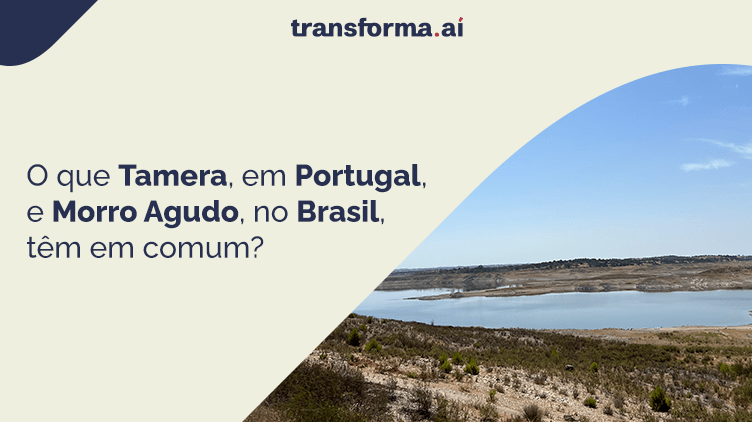
What do Tamera, in Portugal, and Morro Agudo, in Brazil, have in common?
Every year we witness extreme weather events around the world. This year, for example, we saw Europe face terrifying heat waves that cause, among other things, wildfires that consume territories and lives, reminding us that global warming is real and already severely influencing our lives.
Most global crises, especially those related to water, such as water scarcity, droughts, desertification, floods, rising sea levels, and climate change, are symptoms of a prolonged harmful management of rainwater and vegetation. On the other hand, water's an essential element that allows us to find a quick and efficient solution to the global climate catastrophe.
Portugal's one of the countries most affected by the consequences of climate change. According to the national database of rural fires, between January 1st and September 15th, 2023, there were 7,097 rural fires, burning 33,003 hectares. Another alarming statistic is released by World Resources Institute (WRI) predicts that by 2040, 26 countries in the world will face a ‘high risk’ of water stress. Portugal's one of them.
Interestingly, it's precisely in Portugal that we find an example of combating climate change that is thriving in the Alentejo region, where the country experiences the most droughts.
Tamera, an example to be followed.
For years, Tamera – an International Research Center – has practiced a water management model designed to capture, store, and infiltrate rainwater, returning the natural water cycle to the property.
Transforma.aí visited the region for the first time in 2022, when our Founding Partner, Samuel Protetti, participated in a course on water retention landscapes. At the time, part of the team was in Portugal dedicated to the work developed with Casa do Impacto, our first partner in the country (read a specific article on the subject here).
Now it was the turn of two environmental educators from the Transforma.aí team to return to Tamera to carry out the same training. Both are part of the "People Caring for the Waters" project in Brazil, by Nexa Resource, which is already a success story in the Morro Agudo-MG region for its ability to increase the water volume of the Batuque stream and raise awareness among farmers and students about the preservation of the territory's water resources, including the application of technologies that are part of the water retention landscapes that they are now exploring in Tamera.
If there's one thing everyone who visits the region experiences, it's the sudden change in scenery and climate observed upon entering.It's as if we're suddenly in another country; the vegetation is different, and the air humidity is incomparable to what you experience around Tamera." "comments Vivian Moreira, project coordinator."
Innovative approaches
Before taking action, Tamera faced complex water-related challenges, including soil desertification and seasonal flooding. It is these innovative approaches that have helped the region overcome these challenges and teach the world the right steps to take.
The key to success is managing the water cycle, and to that end, hundreds of infiltration areas and forest strips have been implemented in the region, capturing rainwater and infiltrating it into the soil. This technology not only helps retain water but also has a positive impact on the region's microclimate, increasing air humidity and becoming a powerful ally in the fight against climate change.
During our incredible learning journey in Portugal, we also had the opportunity to discover other technologies that are revolutionizing how we address water and soil challenges. Below, we share some of them and their consequences:
Infiltration trenches: Channels built along the contour lines of the landscape serve to retain rainwater and allow it to infiltrate slowly into the soil, contributing to efficient water management.
Terraços: Flat planting areas in gardens and orchards, preventing erosion and replenishing wells.
Contour barriers: constructed with logs along the contours of the landscape. These barriers not only protect against soil erosion, but also enrich the soil with organic matter, promoting soil health.
Infiltration basins: Designed to collect rainwater around vegetation, these basins have a level, shallow bottom, allowing for efficient water absorption into the soil.
Palisades: permeable barriers're constructed in areas where water naturally accumulates and flows. These structures slow the flow of water, allowing it to seep into the soil, and also help combat erosion and improve wildlife corridors.
Ground cover: a technique that consists of not leaving the land bare, either through sowing or by adding plant cover. It is based on the principle that a covered area improves water infiltration and retention in the soil.
More important than the technologies themselves is their management, from planning to continuous maintenance to ensure efficiency. Just as extensive work was done with farmers in Tamara to consolidate the water retention landscape as a practical reality in the region, the "People Caring for the Water" project in Minas Gerais aims to do the same.
In this final phase with Nexa Resources, the farmers participating in the project were presented with a plan for the implementation and maintenance of a set of environmental technologies that best adapt to each of their properties, so that together the landscape of the territory can be transformed.
"Our intention's that these small landowners can manage their water resources continuously and autonomously, including the implementation of other complementary environmental technologies." concludes Viviane.
The innovations we found in Tamera show us how careful and strategic water and soil management can have a positive impact on socio-environmental conditions. We're excited to apply this knowledge to future projects as well; by using these sustainable practices, we can move towards a healthier and more viable world for future generations.

